Diagnostic Medical Sonography

The Associate Degree in Diagnostic Medical Sonography program emphasizes high-quality patient care, technical excellence, and professional standards of practice. The curriculum is designed to strengthen students’ leadership skills, ethical decision-making, and civic responsibility, preparing graduates to contribute meaningfully to their workplaces and communities. This program will begin in 2027.

Image
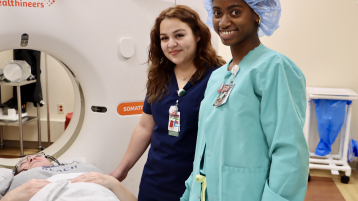
Smiling sonography student in scrubs standing next to an imaging machine

What is Diagnostic Medical Sonography?

Diagnostic Medical Sonography is a challenging and rewarding career well suited for individuals who enjoy science, technology, and patient interaction in a fast-paced healthcare environment.

A Diagnostic Medical Sonographer is a highly skilled healthcare professional who uses ultrasound technology to produce images of internal body structures that help physicians evaluate and diagnose medical conditions.

Sonographers are more than equipment operators. They play a vital diagnostic role that requires a strong understanding of anatomy, physiology, and pathology, along with the ability to think critically in real time. Through extensive hands-on clinical experience, sonographers learn to recognize normal and abnormal findings, evaluate ultrasound images as they are acquired, and apply clinical judgment to support accurate patient care. Sonographers work in hospitals in specialized labs or general imaging units, physicians’ offices such as OB/GYN clinics, or outpatient care centers. They are employed in medical and diagnostic labs and some work with imaging equipment companies that design, manufacture, and sell ultrasound equipment. 

MassBay's Program

The Associate Degree in Diagnostic Medical Sonography combines classroom instruction, laboratory practice, and supervised clinical experiences to prepare students for careers in medical imaging. 

This is a full-time program designed to be completed over six semesters (including two summers), with a Fall semester start. Our program offers a robust curriculum that includes preparation for both ARRT (American Registry of Radiologic Technologists) and ARDMS (American Registry for Diagnostic Medical Sonography) certification exams, preparing graduates for entry-level employment in the profession. 

The theoretical and clinical components of diagnostic medical sonography courses must be taken concurrently and sequentially, as outlined in the program curriculum sheet. 

Admissions Requirements

Applicants seeking admission to the Associate Degree Diagnostic Medical Sonography program are required to attend a recent information session. The times and dates for these sessions can be found on the Information Session webpage.

For the Fall 2026 cohort, applicants must have an Associate in Science degree in an Allied Health discipline or a Bachelor of Science degree

Students seeking admission to the Associate Degree Diagnostic Medical Sonography program will be individually evaluated based on Grade Point Average (GPA) and performance on the Assessment Technologies Institute Test of Essential Academic Skills (ATI TEAS) exam.

To be considered for admission, students must have all the following:  

  • High school diploma or equivalent, or associate degree or higher   
  • An overall college GPA of 2.5 or higher  
  • Students must achieve passing scores on the ATI TEAS. Passing scores are defined as a minimum composite score of 63%.   
  • Students may repeat the TEAS test twice within 12 months of taking it. Results are valid for three years.  

Applicants must also meet the following additional criteria for acceptance into the diagnostic medical sonography program:

  • MassBay Placement into English Composition I (EN 101) or completion of English Composition I and Accelerated English Lab (EN 101 and EN 101L Co-Requisite)
  • Completion of a three-credit (3) College Algebra or four-credit (4) Pre-Calculus course. At MassBay College, Algebra (MA 102) or Pre-Calculus (MA 104) with a grade of C or higher.1  
  • Completion of BI 215 Anatomy and Physiology I and BI 217 Anatomy and Physiology II * within a five-year time frame with a grade of C+ or higher at the time student records are reviewed for matriculation into the diagnostic medical sonography program (Note: students may repeat each science course only once to achieve a C+ within the required 5-year period). Challenge examinations are available for BI 215 Anatomy and Physiology I and BI 217 Anatomy and Physiology II if the applicant has completed the coursework, including the associated labs, with a grade of C+ or higher beyond the five-year limit.
  • Completion of a 3-credit (3) Medical Terminology (MassBay HL 103) with a grade of C or higher.
  • Documentation from a healthcare provider stating that you have a positive Hepatitis B Antibody titer or have completed the Hepatitis B vaccine series and are a “non-responder” to the vaccine. 

Program Mission Statement

The Diagnostic Medical Sonography Program provides comprehensive education and training that prepares students with the knowledge, technical skills, and professional competencies required to perform high-quality sonographic procedures. The program promotes academic excellence, clinical proficiency, and compassionate patient care while advancing the medical imaging profession. It is also committed to community engagement through collaborative healthcare partnerships, outreach initiatives, and the preparation of graduates who are responsive to the evolving needs of diverse populations. 

Program Goals

The program seeks to:

  1. Prepare competent, entry-level general sonographers in the cognitive (knowledge), psychomotor (skills), and affective (behavior) learning domains in abdominal sonography-extended, obstetrics, and gynecology.
  2. Support student success and retention through effective use of the college’s academic and personal support services.
  3. Monitor graduate employment outcomes and gather feedback from graduates and employers to identify strengths and areas for improvement.
  4. Provide opportunities for professional development, career transition, and lifelong learning consistent with the college’s mission.
  5. Regularly evaluate and adapt the curriculum to reflect advancements in healthcare and medical imaging.
  6. Promote excellence in education, collaboration, and leadership within the healthcare community while serving as a resource for clinical partners.